Hi avid followers of this blog. I have a lovely post from Rich Fabend today. It is always truly compelling to see how he approaches his life and his experiences in creating adaptive equipment for his personal use. Below is a really neat post from Rich.
Rich Fabend
Would you like to raise some flowers and/or grow some vegetables for your own consumption? Raised bed garden boxes will let you do that and it is great exercise. Each spring the soil must be worked up and planted. During the growing season the vegetables must be weeded and thinned. If the weather is not cooperating the plants must be watered. The wilted flower heads must be picked off the plants (called deadheading) which is great exercise for fingers. A box does not take up much room if space is an issue. Prior to placing a box, the area under it must be prepared. This is not necessary if it will be placed on cement or any other solid surface. If placed on the ground you must assure good drainage.
The height of the box opening should be a few inches taller than the armrests of the wheelchair. The width of the growing area should be several inches less than twice the gardener’s arm length which will allow one to cover the entire planting area. Built from pressure treated lumber, the box is open on two sides so one can drive a wheelchair underneath it and work straight on.
The first year my boxes presented some unique problems because of the construction. The 2” by 8” which made up the planting area did not allow for the soil to be deep enough for vegetables so most of the vegetables planted did not grow very well. The following year, as you can see from the picture, we added about 3 inches to the height of the planting area. This allowed adding another 250 pounds of soil to the bed. Also, in an effort to cut down on moisture evaporation we added Hydro-Sorb to the soil. Hydro-Sorb retains water and releases it a little at a time. These two changes made the boxes much more successful. We did not find it necessary to increase the depth of the flower boxes.
I have 6 boxes, four I plant with vegetables and the other two with annual flowers. I enjoy working these boxes very much. I use adaptive garden tools which can be purchased online. The vegetable boxes can grow salt potatoes, broccoli, onions, baby carrots, beets and garlic. Gardening is good for many different reasons.

Showing posts with label attitude. Show all posts
Showing posts with label attitude. Show all posts
Wednesday, September 1, 2010


Tuesday, August 3, 2010
Another fabulous blog post from the amazing Rich Fabend
I am truly excited to be publishing another post from our amazing blogger Rich Fabend. We've been missing his wise words here, I hope you enjoy the next reading from him.
Rich Fabend
 If you had your television on during the last five or six weeks, it would be hard to have missed some life lessons that were taking place. We have been able to watch a variety of world-class athletes participating in the sports that they love. Thirty-two of the world's best football (soccer) teams arrived in South Africa to participate in the World Cup. South Africa was a showcase for what can happen when people choose to work together. In the not so distant past South Africa was in the throws of the racial policy called Apartheid. The South Africans obviously have made great strides under the leadership of their new government.
 On July 3 another world class sporting event began. The Tour de France is a yearly event which challenges almost 200 top athletes from all over the globe to a grueling bike race which lasts 20 days and covers 3642 kilometers or a little over 2185 miles. Twenty-two teams of nine racers each put their collective and individual skills to the test. On an average day the racers cover over 100 miles. Some stages are flat, some rolling and some are on extremely mountainous terrain. The downhill speeds can exceed 60 miles an hour. The bikers race for personal and team success. This is a great test of human endurance both physical and mental, and if we look carefully there is much to be learned. The race presents different challenges to the participants every day. With the large number of racers moving along in tight proximity to each other there are often crashes. Effects of these can range from “road rash” to broken bones. Even racers with broken bones refused to drop out of the race. This year Cadel Evans, a rider from Australia, rode most of the way with a broken wrist. When mishaps happen to a team leader and he falls behind, his teammates drop back to help him catch back up to the group of riders. The person riding in the front of the line cuts the wind which reduces the work the riders behind him must do by as much as 40%. This is called splitstream or more commonly known as drafting. Team members are constantly changing this front position to keep members fresh. At times racers from different teams will even do this in pursuit of a common goal. Each team has racers called domestiques who keep team members supplied with water. They must drop back to the support cars behind the racers get a number of bottles and then sprint up to the group to hand the bottles out. Everyone works for the good of the team. In the end with the help of his team members Alberto Contador of Spain won the race. However, all the riders were successful just finishing such a grueling race.
Racers also must deal with extreme weather conditions. Over the 21 days in the race riders often struggle with road temperatures that can reach 100°. When they are in the mountains, temperatures can drop as much as 50° from the bottom to the top of the mountain. Often at the summit bystanders will hand them newspapers which the riders place inside their jerseys to help insulate their bodies from windchill experienced on the descent. Sometimes, individual racers will have days when they just are unable to work at professional levels. But like most of the racers on the tour they refuse to give up.
I believe there are lessons to be learned for all of us from watching these professional athletes. We can learn commitment, teamwork to achieve common goals, and refusing to allow pain and fatigue to sidetrack us from our purposes even though we could easily find an excuse to give up. My final observation would be that the challenges and subsequent lessons to be learned here are not just challenges faced by athletes but confront all people in day to day situations including people with disabilities.
Rich Fabend
 If you had your television on during the last five or six weeks, it would be hard to have missed some life lessons that were taking place. We have been able to watch a variety of world-class athletes participating in the sports that they love. Thirty-two of the world's best football (soccer) teams arrived in South Africa to participate in the World Cup. South Africa was a showcase for what can happen when people choose to work together. In the not so distant past South Africa was in the throws of the racial policy called Apartheid. The South Africans obviously have made great strides under the leadership of their new government.
Generally speaking the teams played with great congeniality. Even Spain, the winner of the World Cup, did not win all their games. We must be careful not to define them as the only winner because by doing so we create the implication that the other thirty-one teams were losers. Winning and success are not synonymous; one can be successful without winning, both in athletics and in our personal lives. While there was joy and heartbreak after every individual game, even the players who lost should not be considered losers. The games were refereed by individuals from all over the world. On the whole they did a wonderful job, but some serious errors in judgment were made by a few referees which had monumental effects on some of the teams. Even in the heat of battle the players generally accepted these decisions with little or no protest. We should recognize that the majority of times most people are making decisions to the best of their ability. There were teams in which the star players failed to fulfill expectations and at other times different players unexpectedly stepped up.
 On July 3 another world class sporting event began. The Tour de France is a yearly event which challenges almost 200 top athletes from all over the globe to a grueling bike race which lasts 20 days and covers 3642 kilometers or a little over 2185 miles. Twenty-two teams of nine racers each put their collective and individual skills to the test. On an average day the racers cover over 100 miles. Some stages are flat, some rolling and some are on extremely mountainous terrain. The downhill speeds can exceed 60 miles an hour. The bikers race for personal and team success. This is a great test of human endurance both physical and mental, and if we look carefully there is much to be learned. The race presents different challenges to the participants every day. With the large number of racers moving along in tight proximity to each other there are often crashes. Effects of these can range from “road rash” to broken bones. Even racers with broken bones refused to drop out of the race. This year Cadel Evans, a rider from Australia, rode most of the way with a broken wrist. When mishaps happen to a team leader and he falls behind, his teammates drop back to help him catch back up to the group of riders. The person riding in the front of the line cuts the wind which reduces the work the riders behind him must do by as much as 40%. This is called splitstream or more commonly known as drafting. Team members are constantly changing this front position to keep members fresh. At times racers from different teams will even do this in pursuit of a common goal. Each team has racers called domestiques who keep team members supplied with water. They must drop back to the support cars behind the racers get a number of bottles and then sprint up to the group to hand the bottles out. Everyone works for the good of the team. In the end with the help of his team members Alberto Contador of Spain won the race. However, all the riders were successful just finishing such a grueling race.
I believe there are lessons to be learned for all of us from watching these professional athletes. We can learn commitment, teamwork to achieve common goals, and refusing to allow pain and fatigue to sidetrack us from our purposes even though we could easily find an excuse to give up. My final observation would be that the challenges and subsequent lessons to be learned here are not just challenges faced by athletes but confront all people in day to day situations including people with disabilities.
Wednesday, June 16, 2010
Wishes and Daydreams

Rich Fabend
June is the month for high school graduation in the States. Both of my nurses have children graduating from high school this year. My primary nurse has been with me for almost 11 years now. Her children are almost like grandchildren to my wife and me. It is her son Devin who's graduating. When he was young we used to play together. Over the years he has done work around our house, has stayed with me overnight when my wife was away (we call it Adult Sitting) and I've watched him grow up. He is a fine young man, as well as a good soccer player and I've seen him play a number of times. Devin will be going into the United States Navy, after graduation, and will train to be corpsman.
 I'm envious! He's young and I'm old. He's got his life ahead of him; most of mine is behind me. He's fit and I am not. I want to be him, young, healthy, virile with so much to look forward to. Just the other night I was thinking it is too bad life doesn’t begin at old age and go backward to childhood. However, wishing and daydreaming isn't going to change my situation. But what it does do is help me look at my life and put things in perspective. People come and go every day and little changes in the grand scheme of things. All this is wishful thinking, I guess, but the reality is only the earth goes on. It reminds me of part of the Serenity Poem which was stuck on a bulletin board in the kitchen at my best friend’s house.
God grant me the serenity
to accept the things I cannot change;
courage to change the things I can;
and wisdom to know the difference.
Reinhold Niebuhr
So, all things considered, what is the lesson to be learned? Deal in reality, enjoy your life as it is, change what you can and take time each day to smell the roses. We are not here very long so we should make the best of our situation.
Tuesday, April 27, 2010
Time to Walk the Walk
Rich Fabend
In my previous three blogs I have encouraged individuals with disabilities to change their attitude, be willing to take some risks and begin to try some different ways to make their lives a little easier. I talked the talk but now it is time for me to walk the walk and show you some things that I’ve done to adapt equipment for my use. Below is a materials list of items that will be helpful to have around for making adjustments to things you use.
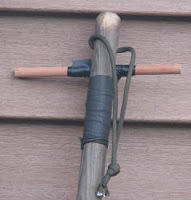
 The turning of the tool in my hands frustrates me to no end. I have used several different adaptions to help me control them. A rake or broom is of little use if it turns over when one goes to use it. In order to stop the roll over I drill a hole in the end of the handle, if there is not already one, and insert a piece of dowel, round pieces of wood of varying diameters. A piece of tape on either side of the shaft will hold the dowel in place or I attach the dowel through the hole using a rubber band. This enables my wife to remove the dowel if it gets in her way. In the picture I am loading the wheelbarrow with straw I have raked by turning the rake over and sliding it under the straw. Holding on to the dowel prevents the rake from rolling over.
We have a wire wreath-like birdfeeder which is filled with peanuts. We then hang the wreath outside for Blue Jays and other birds. They will pull the peanuts out one by one. As you can see in the video, the kitchen floor is quite a mess when I finish. So I use the broom I have adapted to clean up. Use this technique on other long handled tools like a mop, leaf rake and other garden tools.
In my previous three blogs I have encouraged individuals with disabilities to change their attitude, be willing to take some risks and begin to try some different ways to make their lives a little easier. I talked the talk but now it is time for me to walk the walk and show you some things that I’ve done to adapt equipment for my use. Below is a materials list of items that will be helpful to have around for making adjustments to things you use.

Cable ties, Clamps, Clips, Compression bandage, Duct tape, Friction tape, Foam, Hose Clamps, Pipe Insulation, PVC Pipe, Straps and Webbing, String and Shoelaces, Velcro, Wooden Dowels.
My hands are normally in a loose grip position. It is almost impossible for me to grip anything tightly. In order to hold on tight my hands must be strapped on to the object. I noticed lacrosse and hockey players wrap tape repeatedly around the same spot on their sticks to prevent their hands from sliding off the stick, so I decided to try it. If you look at the attached video (Adapting a Broom) you will see how I use friction tape and a piece of wooden dowel to enable me to use a broom. The friction tape has been used to make what I call a “stop.” On a long handle, such as a broom or rake, you should decide where you want your lower hand positioned and place the “stop” right there. Wrap tape repeatedly around the same spot until you have built up a raised area on the handle. Grip the broom or rake as best you can. When your hand slides up the handle it will come to rest against the “stop” and prevent any further upward movement.
 The turning of the tool in my hands frustrates me to no end. I have used several different adaptions to help me control them. A rake or broom is of little use if it turns over when one goes to use it. In order to stop the roll over I drill a hole in the end of the handle, if there is not already one, and insert a piece of dowel, round pieces of wood of varying diameters. A piece of tape on either side of the shaft will hold the dowel in place or I attach the dowel through the hole using a rubber band. This enables my wife to remove the dowel if it gets in her way. In the picture I am loading the wheelbarrow with straw I have raked by turning the rake over and sliding it under the straw. Holding on to the dowel prevents the rake from rolling over.
We have a wire wreath-like birdfeeder which is filled with peanuts. We then hang the wreath outside for Blue Jays and other birds. They will pull the peanuts out one by one. As you can see in the video, the kitchen floor is quite a mess when I finish. So I use the broom I have adapted to clean up. Use this technique on other long handled tools like a mop, leaf rake and other garden tools.
Tuesday, April 13, 2010
Dealing with Risk
Rich Fabend
If you read my other two blog entries Attitude, Attitude, Attitude and Attitude Adjustment, hopefully you are beginning to understand that it is a combination of your attitude and an ongoing process that are necessary to begin to deal with some of your daily frustrations. There is another barrier to some people’s efforts to think beyond traditional methods of accomplishing an objective. That obstacle is the concept of failure. Dealing with life's adversities often involves risk and along with risk comes the idea of success or failure. We are often reluctant to take a risk for fear we may not be able to accomplish what we are trying to do and that implies failure. First of all, nobody always achieves what they set out to do. Secondly, many individuals have the misconception that failure is bad. However, failure if approached with a positive attitude, provides opportunity for learning and hence for growth. In a “60 Minutes” interview LeBron James, the famous NBA basketball player, was asked what advice he would give to young kids, his response was not to be afraid to fail. LeBron James said, “Don’t be afraid of failure".
Making adaptive equipment often involves a learning process that includes a change in attitude. If you have an idea for creating a piece of adaptive equipment, pursue it. Remember for all of us, thinking out of the box is a strategy that can lead us down the road to success. When making adaptive equipment try to keep things simple. Use materials that are readily available and make the tools multifunctional if possible. Do not let yourself become discouraged for very few things happen quickly. Learning to approach a task with a new outlook will take time. However, success breeds success and after awhile you will look at things differently. Look at a new situation not as a problem, but as a challenge needing to be addressed. Set your mind free of the cultural restraints which may prevent you from finding a solution. The following poem hung on the wall in my classroom for years.
ONLY A PERSON WHO RISKS IS FREE
Author Unknown
To laugh is to risk appearing the fool.
To weep is to risk appearing sentimental.
To reach for another is to risk involvement.
To expose your ideas, your dreams, before a crowd is to risk their loss.
To love is to risk not being loved in return.
To live is to risk dying.
To believe is to risk despair.
To try is to risk failure.
But risks must be taken, because the greatest hazard in life is to risk nothing.
The people who risk nothing, do nothing, have nothing, are nothing.
They may avoid suffering and sorrow, but they cannot learn, feel, change, grow, love, live.
Chained by their attitudes they are slaves; they have forfeited their freedom.
Only a person who risks is free.
~ from page 147 of the book "Addiction by Prescription" by Joan Gadsby
Tuesday, March 30, 2010
Attitude Adjustment
Rich Fabend
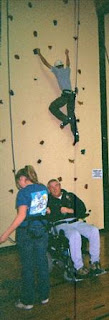 The radical physical and mental changes I went through following my accident were overwhelming. My mental rehabilitation lagged behind, slowed by two major thoughts. I had retired seven months prior, at age 55, looking forward to spending the years ahead pursuing the recreational activities I enjoyed so much. One of my biggest concerns adjusting to my new life was the belief that I would not be able to return to the activities which provided me with quality of life. I also feared my most productive days were behind me and I would simply exist for the rest of my life. The change in my outlook began during a recreation field trip to the Denver Zoo. I was accompanied on this field trip by my daughter and two grandchildren. As I watched my grandchildren running around and listened to their questions and the talk of others around me, I began to realise I still had much to share.
The ongoing process of mental recovery was greatly influenced by my former association with the martial arts and Project Adventure. The martial arts stress the mind body connection, focusing one’s mental energy and looking at issues as challenges to be solved rather than problems with which to be dealt. Project Adventure (PA) “… is a challenging outdoor personal development and team building activity which usually consists of high and/or low elements. Low elements take place on the ground or only a few feet above the ground. High elements are usually constructed in trees or made of utility poles and require a belay (being a attached to a safety line) for safety.” (wikipedia.org/wiki/Ropes course). PA helped me understand what success and failure means, and I learnt about commitment and alternative ways of solving problems. The importance of the mind, the thought process and one’s attitude facing challenges became very clear to me. When trying to accomplish a task, I believe it is human nature to rely on a method which has been successful in the past. This often encourages us to use only limited means to accomplish a particular goal. If I asked 10 people, most anywhere in the United States, to catch a fish chances are almost all of them would grab a fishing pole since this method has been successful and therefore widely used in our culture. Initially when dealing with the challenges placed on people by a disability, I think they often try to solve problems using the same skills they used before their impairment. This approach can create extreme frustration and an acute awareness of the limitations placed on them by their condition. In reality, if we think about it, there are usually many ways to solve a particular problem. If I presented the same challenge of catching a fish to 10 people who were selected from different cultures around the world we would probably see a wide variety of approaches to accomplishing this task. Fish might be taken with a spear, bow and arrow, casting a net, using a gill net, with fish traps, use of hands (one hand method is called Noodling) or use of another animal like a cormorant. With this example it becomes apparent that there are a lot of different ways to accomplish a given task. So learn to think outside the box and experiment with different approaches.
My introduction to adaptive equipment began one day when I dropped a piece of paper on the floor. Because of my level of injury I was constantly dropping things and then having to call my wife or nurse to pick them up for me. I knew something had to change. How would my attitude toward picking up that piece of paper affect me? If I decided I could not pick up the paper, chances are it would foster a negative feeling of defeat which then could further my disability. It took me quite a while and involved a lot of failure and frustration to reach the point where I am today. If at first you don't succeed try, try again. How many times have we heard that? I have learnt over the last eleven years that if you have an open mind and an active brain you can always find different ways or methods to solve most of the challenges we face. It is just a matter of how much thought, time and perseverance you are willing to commit to the process.
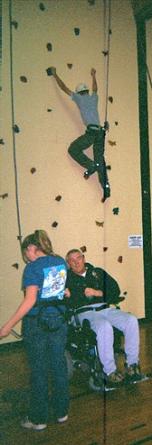
The ongoing process of mental recovery was greatly influenced by my former association with the martial arts and Project Adventure. The martial arts stress the mind body connection, focusing one’s mental energy and looking at issues as challenges to be solved rather than problems with which to be dealt. Project Adventure (PA) “… is a challenging outdoor personal development and team building activity which usually consists of high and/or low elements. Low elements take place on the ground or only a few feet above the ground. High elements are usually constructed in trees or made of utility poles and require a belay (being a attached to a safety line) for safety.” (wikipedia.org/wiki/Ropes course). PA helped me understand what success and failure means, and I learnt about commitment and alternative ways of solving problems. The importance of the mind, the thought process and one’s attitude facing challenges became very clear to me. When trying to accomplish a task, I believe it is human nature to rely on a method which has been successful in the past. This often encourages us to use only limited means to accomplish a particular goal. If I asked 10 people, most anywhere in the United States, to catch a fish chances are almost all of them would grab a fishing pole since this method has been successful and therefore widely used in our culture. Initially when dealing with the challenges placed on people by a disability, I think they often try to solve problems using the same skills they used before their impairment. This approach can create extreme frustration and an acute awareness of the limitations placed on them by their condition. In reality, if we think about it, there are usually many ways to solve a particular problem. If I presented the same challenge of catching a fish to 10 people who were selected from different cultures around the world we would probably see a wide variety of approaches to accomplishing this task. Fish might be taken with a spear, bow and arrow, casting a net, using a gill net, with fish traps, use of hands (one hand method is called Noodling) or use of another animal like a cormorant. With this example it becomes apparent that there are a lot of different ways to accomplish a given task. So learn to think outside the box and experiment with different approaches.
My introduction to adaptive equipment began one day when I dropped a piece of paper on the floor. Because of my level of injury I was constantly dropping things and then having to call my wife or nurse to pick them up for me. I knew something had to change. How would my attitude toward picking up that piece of paper affect me? If I decided I could not pick up the paper, chances are it would foster a negative feeling of defeat which then could further my disability. It took me quite a while and involved a lot of failure and frustration to reach the point where I am today. If at first you don't succeed try, try again. How many times have we heard that? I have learnt over the last eleven years that if you have an open mind and an active brain you can always find different ways or methods to solve most of the challenges we face. It is just a matter of how much thought, time and perseverance you are willing to commit to the process.
Wednesday, March 17, 2010
Attitude, Attitude, Attitude!

I can only speak from my own personal experiences, sharing what I have learned and what I believe to be important.
Attitude, Attitude, Attitude I have become convinced over the last eleven years that attitude is much more important to individuals who are physically challenged than ability. To look on a new situation not as a problem but as a challenge needing to be met, may actually set one’s mind free of the mental restraints which prevent one from finding a solution.
Attitude towards the future will play a great role in how one adapts to any new lifestyle. I am sure there are many people who would look at me confined to a wheelchair and think that it is probably one of the worst things that could happen to anyone. It doesn't matter what other people think, what is important is what I think. I had little control over what happened to me but I have almost complete control over how I deal with my situation, and feeling in control is critical to progress and recovery. What I believe and how I handle the results of my accident will determine how I live and enjoy the rest of my life. I have good days and bad days but ultimately the control of my situation and attitude rests within me.
I know I have the ability to cope with what has happened to me, and I can decide how I will handle this and subsequent challenges I will face. The strength to deal positively with any challenge is in every one of us. I do not see myself as a person with a disability I see myself as being challenged. Christopher Reeve said "I refuse to allow a disability to determine how I will live my life. I don't mean to be reckless, but setting a goal that seems a bit daunting actually is very helpful toward recovery."
Subscribe to:
Posts (Atom)