Hi avid followers of this blog. I have a lovely post from Rich Fabend today. It is always truly compelling to see how he approaches his life and his experiences in creating adaptive equipment for his personal use. Below is a really neat post from Rich.
Rich Fabend
Would you like to raise some flowers and/or grow some vegetables for your own consumption? Raised bed garden boxes will let you do that and it is great exercise. Each spring the soil must be worked up and planted. During the growing season the vegetables must be weeded and thinned. If the weather is not cooperating the plants must be watered. The wilted flower heads must be picked off the plants (called deadheading) which is great exercise for fingers. A box does not take up much room if space is an issue. Prior to placing a box, the area under it must be prepared. This is not necessary if it will be placed on cement or any other solid surface. If placed on the ground you must assure good drainage.
The height of the box opening should be a few inches taller than the armrests of the wheelchair. The width of the growing area should be several inches less than twice the gardener’s arm length which will allow one to cover the entire planting area. Built from pressure treated lumber, the box is open on two sides so one can drive a wheelchair underneath it and work straight on.
The first year my boxes presented some unique problems because of the construction. The 2” by 8” which made up the planting area did not allow for the soil to be deep enough for vegetables so most of the vegetables planted did not grow very well. The following year, as you can see from the picture, we added about 3 inches to the height of the planting area. This allowed adding another 250 pounds of soil to the bed. Also, in an effort to cut down on moisture evaporation we added Hydro-Sorb to the soil. Hydro-Sorb retains water and releases it a little at a time. These two changes made the boxes much more successful. We did not find it necessary to increase the depth of the flower boxes.
I have 6 boxes, four I plant with vegetables and the other two with annual flowers. I enjoy working these boxes very much. I use adaptive garden tools which can be purchased online. The vegetable boxes can grow salt potatoes, broccoli, onions, baby carrots, beets and garlic. Gardening is good for many different reasons.

Showing posts with label User Friendly. Show all posts
Showing posts with label User Friendly. Show all posts
Wednesday, September 1, 2010


Wednesday, July 7, 2010
Adapting Some Winter Clothing
Another fabulous blog from Rich Fabend!

 I know that June, July and August are the winter months in Australia. Right now it is summer, in the States, but it has not been very warm. Much of the time, regardless of the season, I am cold. In my blogs I have been trying to encourage people to think of different methods and telling them that there is more than one way to solve a problem. Here are some things I have done to try to stay warm. My problem was trying to keep my hands and arms warm when I was outside. My fingers are always clenched in a loose fist position. It was very difficult for my wife or nurse to put regular gloves on my hands. It quickly became evident that mittens would work best. Unfortunately, mittens created problems of their own. It was impossible to keep my thumb in the thumb of the mitten. The major problem with mittens however, was that once I took them off I was unable to get them back on by myself. So I designed what I like to call Quad Mitts. They have an opening at each end with the front one tighter. I was able to get my wife's friend to knit a trial pair and they worked extremely well. The picture below shows the pattern that we used. Note that the cuff is extra long and can be folded over what I am wearing so I don't have to worry about them coming off. When I need to use my bare hand I just push it though the hole in the front end and then pull the end back over my hand when I am finished. I am a big man so you may need to adjust the measurements according to your own size. If you know someone who will knit for you maybe you want to think about a pair of sleeves (my arms are always cold) and/or leg warmers. Often in the morning I will have my nurse put my sleeves on with a tee-shirt and then I will take them off when the day warms up. Recently I cut out part of the back of a sweatshirt. I am able to put the sweatshirt on and take it off by myself and it’s not necessary to worry about pulling it down behind me. This was a simple thing to do but it keeps most of the parts of my body I can feel warm.


 I know that June, July and August are the winter months in Australia. Right now it is summer, in the States, but it has not been very warm. Much of the time, regardless of the season, I am cold. In my blogs I have been trying to encourage people to think of different methods and telling them that there is more than one way to solve a problem. Here are some things I have done to try to stay warm. My problem was trying to keep my hands and arms warm when I was outside. My fingers are always clenched in a loose fist position. It was very difficult for my wife or nurse to put regular gloves on my hands. It quickly became evident that mittens would work best. Unfortunately, mittens created problems of their own. It was impossible to keep my thumb in the thumb of the mitten. The major problem with mittens however, was that once I took them off I was unable to get them back on by myself. So I designed what I like to call Quad Mitts. They have an opening at each end with the front one tighter. I was able to get my wife's friend to knit a trial pair and they worked extremely well. The picture below shows the pattern that we used. Note that the cuff is extra long and can be folded over what I am wearing so I don't have to worry about them coming off. When I need to use my bare hand I just push it though the hole in the front end and then pull the end back over my hand when I am finished. I am a big man so you may need to adjust the measurements according to your own size. If you know someone who will knit for you maybe you want to think about a pair of sleeves (my arms are always cold) and/or leg warmers. Often in the morning I will have my nurse put my sleeves on with a tee-shirt and then I will take them off when the day warms up. Recently I cut out part of the back of a sweatshirt. I am able to put the sweatshirt on and take it off by myself and it’s not necessary to worry about pulling it down behind me. This was a simple thing to do but it keeps most of the parts of my body I can feel warm.


Tuesday, April 27, 2010
Time to Walk the Walk
Rich Fabend
In my previous three blogs I have encouraged individuals with disabilities to change their attitude, be willing to take some risks and begin to try some different ways to make their lives a little easier. I talked the talk but now it is time for me to walk the walk and show you some things that I’ve done to adapt equipment for my use. Below is a materials list of items that will be helpful to have around for making adjustments to things you use.
 The turning of the tool in my hands frustrates me to no end. I have used several different adaptions to help me control them. A rake or broom is of little use if it turns over when one goes to use it. In order to stop the roll over I drill a hole in the end of the handle, if there is not already one, and insert a piece of dowel, round pieces of wood of varying diameters. A piece of tape on either side of the shaft will hold the dowel in place or I attach the dowel through the hole using a rubber band. This enables my wife to remove the dowel if it gets in her way. In the picture I am loading the wheelbarrow with straw I have raked by turning the rake over and sliding it under the straw. Holding on to the dowel prevents the rake from rolling over.
We have a wire wreath-like birdfeeder which is filled with peanuts. We then hang the wreath outside for Blue Jays and other birds. They will pull the peanuts out one by one. As you can see in the video, the kitchen floor is quite a mess when I finish. So I use the broom I have adapted to clean up. Use this technique on other long handled tools like a mop, leaf rake and other garden tools.
In my previous three blogs I have encouraged individuals with disabilities to change their attitude, be willing to take some risks and begin to try some different ways to make their lives a little easier. I talked the talk but now it is time for me to walk the walk and show you some things that I’ve done to adapt equipment for my use. Below is a materials list of items that will be helpful to have around for making adjustments to things you use.

Cable ties, Clamps, Clips, Compression bandage, Duct tape, Friction tape, Foam, Hose Clamps, Pipe Insulation, PVC Pipe, Straps and Webbing, String and Shoelaces, Velcro, Wooden Dowels.
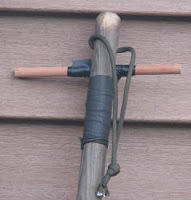
My hands are normally in a loose grip position. It is almost impossible for me to grip anything tightly. In order to hold on tight my hands must be strapped on to the object. I noticed lacrosse and hockey players wrap tape repeatedly around the same spot on their sticks to prevent their hands from sliding off the stick, so I decided to try it. If you look at the attached video (Adapting a Broom) you will see how I use friction tape and a piece of wooden dowel to enable me to use a broom. The friction tape has been used to make what I call a “stop.” On a long handle, such as a broom or rake, you should decide where you want your lower hand positioned and place the “stop” right there. Wrap tape repeatedly around the same spot until you have built up a raised area on the handle. Grip the broom or rake as best you can. When your hand slides up the handle it will come to rest against the “stop” and prevent any further upward movement.
 The turning of the tool in my hands frustrates me to no end. I have used several different adaptions to help me control them. A rake or broom is of little use if it turns over when one goes to use it. In order to stop the roll over I drill a hole in the end of the handle, if there is not already one, and insert a piece of dowel, round pieces of wood of varying diameters. A piece of tape on either side of the shaft will hold the dowel in place or I attach the dowel through the hole using a rubber band. This enables my wife to remove the dowel if it gets in her way. In the picture I am loading the wheelbarrow with straw I have raked by turning the rake over and sliding it under the straw. Holding on to the dowel prevents the rake from rolling over.
We have a wire wreath-like birdfeeder which is filled with peanuts. We then hang the wreath outside for Blue Jays and other birds. They will pull the peanuts out one by one. As you can see in the video, the kitchen floor is quite a mess when I finish. So I use the broom I have adapted to clean up. Use this technique on other long handled tools like a mop, leaf rake and other garden tools.
Subscribe to:
Posts (Atom)