Hi avid followers of this blog. I have a lovely post from Rich Fabend today. It is always truly compelling to see how he approaches his life and his experiences in creating adaptive equipment for his personal use. Below is a really neat post from Rich.
Rich Fabend
Would you like to raise some flowers and/or grow some vegetables for your own consumption? Raised bed garden boxes will let you do that and it is great exercise. Each spring the soil must be worked up and planted. During the growing season the vegetables must be weeded and thinned. If the weather is not cooperating the plants must be watered. The wilted flower heads must be picked off the plants (called deadheading) which is great exercise for fingers. A box does not take up much room if space is an issue. Prior to placing a box, the area under it must be prepared. This is not necessary if it will be placed on cement or any other solid surface. If placed on the ground you must assure good drainage.
The height of the box opening should be a few inches taller than the armrests of the wheelchair. The width of the growing area should be several inches less than twice the gardener’s arm length which will allow one to cover the entire planting area. Built from pressure treated lumber, the box is open on two sides so one can drive a wheelchair underneath it and work straight on.
The first year my boxes presented some unique problems because of the construction. The 2” by 8” which made up the planting area did not allow for the soil to be deep enough for vegetables so most of the vegetables planted did not grow very well. The following year, as you can see from the picture, we added about 3 inches to the height of the planting area. This allowed adding another 250 pounds of soil to the bed. Also, in an effort to cut down on moisture evaporation we added Hydro-Sorb to the soil. Hydro-Sorb retains water and releases it a little at a time. These two changes made the boxes much more successful. We did not find it necessary to increase the depth of the flower boxes.
I have 6 boxes, four I plant with vegetables and the other two with annual flowers. I enjoy working these boxes very much. I use adaptive garden tools which can be purchased online. The vegetable boxes can grow salt potatoes, broccoli, onions, baby carrots, beets and garlic. Gardening is good for many different reasons.

Showing posts with label Adapting Equipment. Show all posts
Showing posts with label Adapting Equipment. Show all posts
Wednesday, September 1, 2010


Wednesday, August 25, 2010
A technology treat
Hi readers,
I realise that it has been a while since this fabulous blog has been updated, but there has been alot of happenings in the IDEAS office as of late. I'm not sure whether it's because the leadup to the silly season has begun, or it's just because we have so many new things happening.
Over my work on the newsletter I came across a really fabulous, new technology that I wanted to share with you. It's designed for people with vision impairment, and it's a program to be used on a Wii console. The great thing about this new technology is that it recognises that ok, adaptive technology that helps people lo live is great and essential for individuals, but this type of equipment allows people to live their lives with a greater level of enjoyment through participation with a technology that has become common to other children. It's all about forgetting difference, and remembering that inside everyone is exactly the same. Check out this little snippet we recieved:
Wii Sports is believed to be a new technological phenomenon that is getting children moving and encouraging activity. The combination of a video game with physical activity has left children and parents happy with video gaming. But what about people with vision impairment?
A video game research project at the University of Nevada, Reno, is in the process of creating Wii
Sports-based PC games that don’t require eyesight to play.
Dr Eelke Folmer and Tony Morelli of the University of Nevada in Reno, Dr John Foley of the State University of New York Cortland and Dr Lauren Lieberman of SUNY Brockport collaborated on the project. They had the goal of creating a gaming device that increases the participation of users with visual
 The two games in the VI Fit line are very similar to Wii Sports games. Both VI Tennis and VI Bowling mimic their respective sports through use of the Wii remote. However instead of seeing the ball and visually lining up the strike, visually impaired players interact using their hearing and feel the games through the use of sound and vibrotactile cues.
VI Bowling uses the Wii remote’s vibration motor to help the blind narrow down when to bowl the ball. Voice effects relay how well the player has done.
Both games are available now for free at the Vi Fit website. Both require a Wii remote and a PC with Bluetooth support to play. If you have problems setting up the game or you have feedback, do not hesitate to contact the makers through the email: feedback@vifit.org.
For more information visit the website www.vifit.org/
Note: the article was taken from Vifit
I realise that it has been a while since this fabulous blog has been updated, but there has been alot of happenings in the IDEAS office as of late. I'm not sure whether it's because the leadup to the silly season has begun, or it's just because we have so many new things happening.
Over my work on the newsletter I came across a really fabulous, new technology that I wanted to share with you. It's designed for people with vision impairment, and it's a program to be used on a Wii console. The great thing about this new technology is that it recognises that ok, adaptive technology that helps people lo live is great and essential for individuals, but this type of equipment allows people to live their lives with a greater level of enjoyment through participation with a technology that has become common to other children. It's all about forgetting difference, and remembering that inside everyone is exactly the same. Check out this little snippet we recieved:
Wii Sports is believed to be a new technological phenomenon that is getting children moving and encouraging activity. The combination of a video game with physical activity has left children and parents happy with video gaming. But what about people with vision impairment?
A video game research project at the University of Nevada, Reno, is in the process of creating Wii
Sports-based PC games that don’t require eyesight to play.
Dr Eelke Folmer and Tony Morelli of the University of Nevada in Reno, Dr John Foley of the State University of New York Cortland and Dr Lauren Lieberman of SUNY Brockport collaborated on the project. They had the goal of creating a gaming device that increases the participation of users with visual
impairments in physical activity, as a means to improve the health of those individuals.
 The two games in the VI Fit line are very similar to Wii Sports games. Both VI Tennis and VI Bowling mimic their respective sports through use of the Wii remote. However instead of seeing the ball and visually lining up the strike, visually impaired players interact using their hearing and feel the games through the use of sound and vibrotactile cues.
VI Bowling uses the Wii remote’s vibration motor to help the blind narrow down when to bowl the ball. Voice effects relay how well the player has done.
Both games are available now for free at the Vi Fit website. Both require a Wii remote and a PC with Bluetooth support to play. If you have problems setting up the game or you have feedback, do not hesitate to contact the makers through the email: feedback@vifit.org.
For more information visit the website www.vifit.org/
Note: the article was taken from Vifit
Wednesday, July 7, 2010
Adapting Some Winter Clothing
Another fabulous blog from Rich Fabend!

 I know that June, July and August are the winter months in Australia. Right now it is summer, in the States, but it has not been very warm. Much of the time, regardless of the season, I am cold. In my blogs I have been trying to encourage people to think of different methods and telling them that there is more than one way to solve a problem. Here are some things I have done to try to stay warm. My problem was trying to keep my hands and arms warm when I was outside. My fingers are always clenched in a loose fist position. It was very difficult for my wife or nurse to put regular gloves on my hands. It quickly became evident that mittens would work best. Unfortunately, mittens created problems of their own. It was impossible to keep my thumb in the thumb of the mitten. The major problem with mittens however, was that once I took them off I was unable to get them back on by myself. So I designed what I like to call Quad Mitts. They have an opening at each end with the front one tighter. I was able to get my wife's friend to knit a trial pair and they worked extremely well. The picture below shows the pattern that we used. Note that the cuff is extra long and can be folded over what I am wearing so I don't have to worry about them coming off. When I need to use my bare hand I just push it though the hole in the front end and then pull the end back over my hand when I am finished. I am a big man so you may need to adjust the measurements according to your own size. If you know someone who will knit for you maybe you want to think about a pair of sleeves (my arms are always cold) and/or leg warmers. Often in the morning I will have my nurse put my sleeves on with a tee-shirt and then I will take them off when the day warms up. Recently I cut out part of the back of a sweatshirt. I am able to put the sweatshirt on and take it off by myself and it’s not necessary to worry about pulling it down behind me. This was a simple thing to do but it keeps most of the parts of my body I can feel warm.


 I know that June, July and August are the winter months in Australia. Right now it is summer, in the States, but it has not been very warm. Much of the time, regardless of the season, I am cold. In my blogs I have been trying to encourage people to think of different methods and telling them that there is more than one way to solve a problem. Here are some things I have done to try to stay warm. My problem was trying to keep my hands and arms warm when I was outside. My fingers are always clenched in a loose fist position. It was very difficult for my wife or nurse to put regular gloves on my hands. It quickly became evident that mittens would work best. Unfortunately, mittens created problems of their own. It was impossible to keep my thumb in the thumb of the mitten. The major problem with mittens however, was that once I took them off I was unable to get them back on by myself. So I designed what I like to call Quad Mitts. They have an opening at each end with the front one tighter. I was able to get my wife's friend to knit a trial pair and they worked extremely well. The picture below shows the pattern that we used. Note that the cuff is extra long and can be folded over what I am wearing so I don't have to worry about them coming off. When I need to use my bare hand I just push it though the hole in the front end and then pull the end back over my hand when I am finished. I am a big man so you may need to adjust the measurements according to your own size. If you know someone who will knit for you maybe you want to think about a pair of sleeves (my arms are always cold) and/or leg warmers. Often in the morning I will have my nurse put my sleeves on with a tee-shirt and then I will take them off when the day warms up. Recently I cut out part of the back of a sweatshirt. I am able to put the sweatshirt on and take it off by myself and it’s not necessary to worry about pulling it down behind me. This was a simple thing to do but it keeps most of the parts of my body I can feel warm.


Friday, May 28, 2010
Patience and Persistence
Hi everyone, welcoming you to another blog from Rich Fabend. Just a side note, we in no way enourage the use of guns or promote hunting or anything of the sort. In Australia their are tight rules and restrictions and definite no-nos about the use of guns. I infact love turkeys as I think they are very fascinating creatures. However I think that there is a great lesson and moral behind the words that Rich has presented in his blog posts here, and that is about patience and adapting to change.
The great thing about his stories is that they portray that anybody can do anything, they just need the support, information and determination to do so. I think that Rich is a really wonderful example of someone who has all these values - not to mention his wonderfully creative mind to top it off. He lives in America and it is currently Hunting season there, thus causing the theme of his posts. But from his posts we can see that disability is a daily thing, however if we learn to live with it in our own way, it moves away from something that runs our life, to something that is part of our being.
Rich Fabend
 I am also proud of myself. Over the 11 years, I got discouraged; turkeys often were close enough to harvest but something always went wrong. In the beginning it was my inability to camouflage my wheelchair well enough, then my finger couldn't pull the trigger, or I had a muscle spasm which alerted the turkeys to my presence and were instantly gone. But I persisted and attempted to correct the challenges as they presented themselves. But at the end of each spring I had the same results -- NOTHING. Often it was a process of trial and error, but gradually my efforts began to improve my chances. I created a trigger adapter which allows me to fire the shotgun using my mouth. Not only does this solve the problem of trying to find the trigger, but it also allows me to use both hands to steady the gun. At many points along the way it would've been easy to give up and quit. I know from experience it's a lot easier to give advice to others than it is to take it myself. So get discouraged, get frustrated, but don’t give up.
The great thing about his stories is that they portray that anybody can do anything, they just need the support, information and determination to do so. I think that Rich is a really wonderful example of someone who has all these values - not to mention his wonderfully creative mind to top it off. He lives in America and it is currently Hunting season there, thus causing the theme of his posts. But from his posts we can see that disability is a daily thing, however if we learn to live with it in our own way, it moves away from something that runs our life, to something that is part of our being.
Rich Fabend
I have waited for this moment for a long time. May 26, 2010 - 9:15 AM. Today I harvested my first turkey in 11 years. I had been an avid hunter prior to my disability. I believed I would never be able to hunt again, especially by myself. Today's success was the result of the labors of many people: my wife, who walked me out and help me set up, my nurse Rhonda, who came at 6 AM the mornings in May so I would have more time to hunt, my neighbor Mike, who allows me to hunt his land, my friend John, who gave me his time to set up blinds made out of snow fence and camouflage material, and so it goes. My wife likes to say "It takes a village".
 I am also proud of myself. Over the 11 years, I got discouraged; turkeys often were close enough to harvest but something always went wrong. In the beginning it was my inability to camouflage my wheelchair well enough, then my finger couldn't pull the trigger, or I had a muscle spasm which alerted the turkeys to my presence and were instantly gone. But I persisted and attempted to correct the challenges as they presented themselves. But at the end of each spring I had the same results -- NOTHING. Often it was a process of trial and error, but gradually my efforts began to improve my chances. I created a trigger adapter which allows me to fire the shotgun using my mouth. Not only does this solve the problem of trying to find the trigger, but it also allows me to use both hands to steady the gun. At many points along the way it would've been easy to give up and quit. I know from experience it's a lot easier to give advice to others than it is to take it myself. So get discouraged, get frustrated, but don’t give up.
 One of the things I like the most about hunting is that it is totally irrelevant to the game that I am an individual with a disability. To the turkeys I hunt, I am just another predator and that's all I ask for. Today was definitely a day worth waiting for.
Tuesday, April 27, 2010
Time to Walk the Walk
Rich Fabend
In my previous three blogs I have encouraged individuals with disabilities to change their attitude, be willing to take some risks and begin to try some different ways to make their lives a little easier. I talked the talk but now it is time for me to walk the walk and show you some things that I’ve done to adapt equipment for my use. Below is a materials list of items that will be helpful to have around for making adjustments to things you use.
 The turning of the tool in my hands frustrates me to no end. I have used several different adaptions to help me control them. A rake or broom is of little use if it turns over when one goes to use it. In order to stop the roll over I drill a hole in the end of the handle, if there is not already one, and insert a piece of dowel, round pieces of wood of varying diameters. A piece of tape on either side of the shaft will hold the dowel in place or I attach the dowel through the hole using a rubber band. This enables my wife to remove the dowel if it gets in her way. In the picture I am loading the wheelbarrow with straw I have raked by turning the rake over and sliding it under the straw. Holding on to the dowel prevents the rake from rolling over.
We have a wire wreath-like birdfeeder which is filled with peanuts. We then hang the wreath outside for Blue Jays and other birds. They will pull the peanuts out one by one. As you can see in the video, the kitchen floor is quite a mess when I finish. So I use the broom I have adapted to clean up. Use this technique on other long handled tools like a mop, leaf rake and other garden tools.
In my previous three blogs I have encouraged individuals with disabilities to change their attitude, be willing to take some risks and begin to try some different ways to make their lives a little easier. I talked the talk but now it is time for me to walk the walk and show you some things that I’ve done to adapt equipment for my use. Below is a materials list of items that will be helpful to have around for making adjustments to things you use.

Cable ties, Clamps, Clips, Compression bandage, Duct tape, Friction tape, Foam, Hose Clamps, Pipe Insulation, PVC Pipe, Straps and Webbing, String and Shoelaces, Velcro, Wooden Dowels.
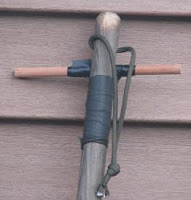
My hands are normally in a loose grip position. It is almost impossible for me to grip anything tightly. In order to hold on tight my hands must be strapped on to the object. I noticed lacrosse and hockey players wrap tape repeatedly around the same spot on their sticks to prevent their hands from sliding off the stick, so I decided to try it. If you look at the attached video (Adapting a Broom) you will see how I use friction tape and a piece of wooden dowel to enable me to use a broom. The friction tape has been used to make what I call a “stop.” On a long handle, such as a broom or rake, you should decide where you want your lower hand positioned and place the “stop” right there. Wrap tape repeatedly around the same spot until you have built up a raised area on the handle. Grip the broom or rake as best you can. When your hand slides up the handle it will come to rest against the “stop” and prevent any further upward movement.
 The turning of the tool in my hands frustrates me to no end. I have used several different adaptions to help me control them. A rake or broom is of little use if it turns over when one goes to use it. In order to stop the roll over I drill a hole in the end of the handle, if there is not already one, and insert a piece of dowel, round pieces of wood of varying diameters. A piece of tape on either side of the shaft will hold the dowel in place or I attach the dowel through the hole using a rubber band. This enables my wife to remove the dowel if it gets in her way. In the picture I am loading the wheelbarrow with straw I have raked by turning the rake over and sliding it under the straw. Holding on to the dowel prevents the rake from rolling over.
We have a wire wreath-like birdfeeder which is filled with peanuts. We then hang the wreath outside for Blue Jays and other birds. They will pull the peanuts out one by one. As you can see in the video, the kitchen floor is quite a mess when I finish. So I use the broom I have adapted to clean up. Use this technique on other long handled tools like a mop, leaf rake and other garden tools.
Subscribe to:
Posts (Atom)