One of the Board Members for IDEAS NSW, Joanna Nicol, writes a magnificent blog about her experiences in a wheelchair, about day-to-day life for a person with disability and about other interesting things that come across her amazing mind. Luckily she has given me permission to share with you one of her blog posts which relates to us. I ofcourse suggest that you have a look at her site though, it is very thoughtful and fascinating.
Joanna Nicol
People find this difficult to believe, but I’m shy. At least in some sense of the word. The way I describe it to people I am not comfortable in a crowd or with starting conversations with strangers. But I see no point in being backward about the obvious factors of my disability.
I might indeed be externally good at socializing but it certainly doesn’t rock my boat and I find it exhausting. Networking especially in a crowded room of people with whom the connection is tenuous is really hard.
Yet there I was the other night in a room full of “uprights” (200 hundred or so of them) representing a NGO I’m on the board of; IDEAS — Information on Disability & Education Awareness Services. We, IDEAS are an information provider on broad base information for people with disability, their family and “supporters”. So basically anything from holiday accommodation with ramps and rails to sign language course referrals to wheelchair repair places and information on the pension; IDEAS can point you in the right direction, at least in New South Wales. For us it’s about enabling participation and choice. (It really is a great service with two other arms too.)
We are a finalist in a category of a small business awards for the local government area. No winners were announced at this event. It was a “networking opportunity” with speeches/advertising from the sponsors. It was crowded. I sat in a corner so that I didn’t knock or get knocked. But I’m proud of myself. From my vantage point I watched people AND talked to people many of whom were I think surprised to see me and us there. I also gave the above spiel, and gave out cards. I wasn’t the first to leave either!
Mission accomplished I think.

Showing posts with label Behavior Tags: Control. Show all posts
Showing posts with label Behavior Tags: Control. Show all posts
Friday, September 3, 2010


Tuesday, March 30, 2010
Attitude Adjustment
Rich Fabend
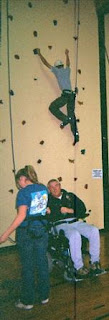 The radical physical and mental changes I went through following my accident were overwhelming. My mental rehabilitation lagged behind, slowed by two major thoughts. I had retired seven months prior, at age 55, looking forward to spending the years ahead pursuing the recreational activities I enjoyed so much. One of my biggest concerns adjusting to my new life was the belief that I would not be able to return to the activities which provided me with quality of life. I also feared my most productive days were behind me and I would simply exist for the rest of my life. The change in my outlook began during a recreation field trip to the Denver Zoo. I was accompanied on this field trip by my daughter and two grandchildren. As I watched my grandchildren running around and listened to their questions and the talk of others around me, I began to realise I still had much to share.
The ongoing process of mental recovery was greatly influenced by my former association with the martial arts and Project Adventure. The martial arts stress the mind body connection, focusing one’s mental energy and looking at issues as challenges to be solved rather than problems with which to be dealt. Project Adventure (PA) “… is a challenging outdoor personal development and team building activity which usually consists of high and/or low elements. Low elements take place on the ground or only a few feet above the ground. High elements are usually constructed in trees or made of utility poles and require a belay (being a attached to a safety line) for safety.” (wikipedia.org/wiki/Ropes course). PA helped me understand what success and failure means, and I learnt about commitment and alternative ways of solving problems. The importance of the mind, the thought process and one’s attitude facing challenges became very clear to me. When trying to accomplish a task, I believe it is human nature to rely on a method which has been successful in the past. This often encourages us to use only limited means to accomplish a particular goal. If I asked 10 people, most anywhere in the United States, to catch a fish chances are almost all of them would grab a fishing pole since this method has been successful and therefore widely used in our culture. Initially when dealing with the challenges placed on people by a disability, I think they often try to solve problems using the same skills they used before their impairment. This approach can create extreme frustration and an acute awareness of the limitations placed on them by their condition. In reality, if we think about it, there are usually many ways to solve a particular problem. If I presented the same challenge of catching a fish to 10 people who were selected from different cultures around the world we would probably see a wide variety of approaches to accomplishing this task. Fish might be taken with a spear, bow and arrow, casting a net, using a gill net, with fish traps, use of hands (one hand method is called Noodling) or use of another animal like a cormorant. With this example it becomes apparent that there are a lot of different ways to accomplish a given task. So learn to think outside the box and experiment with different approaches.
My introduction to adaptive equipment began one day when I dropped a piece of paper on the floor. Because of my level of injury I was constantly dropping things and then having to call my wife or nurse to pick them up for me. I knew something had to change. How would my attitude toward picking up that piece of paper affect me? If I decided I could not pick up the paper, chances are it would foster a negative feeling of defeat which then could further my disability. It took me quite a while and involved a lot of failure and frustration to reach the point where I am today. If at first you don't succeed try, try again. How many times have we heard that? I have learnt over the last eleven years that if you have an open mind and an active brain you can always find different ways or methods to solve most of the challenges we face. It is just a matter of how much thought, time and perseverance you are willing to commit to the process.
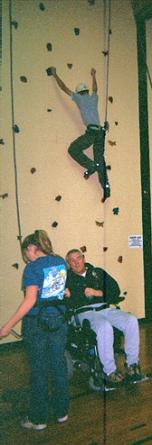
The ongoing process of mental recovery was greatly influenced by my former association with the martial arts and Project Adventure. The martial arts stress the mind body connection, focusing one’s mental energy and looking at issues as challenges to be solved rather than problems with which to be dealt. Project Adventure (PA) “… is a challenging outdoor personal development and team building activity which usually consists of high and/or low elements. Low elements take place on the ground or only a few feet above the ground. High elements are usually constructed in trees or made of utility poles and require a belay (being a attached to a safety line) for safety.” (wikipedia.org/wiki/Ropes course). PA helped me understand what success and failure means, and I learnt about commitment and alternative ways of solving problems. The importance of the mind, the thought process and one’s attitude facing challenges became very clear to me. When trying to accomplish a task, I believe it is human nature to rely on a method which has been successful in the past. This often encourages us to use only limited means to accomplish a particular goal. If I asked 10 people, most anywhere in the United States, to catch a fish chances are almost all of them would grab a fishing pole since this method has been successful and therefore widely used in our culture. Initially when dealing with the challenges placed on people by a disability, I think they often try to solve problems using the same skills they used before their impairment. This approach can create extreme frustration and an acute awareness of the limitations placed on them by their condition. In reality, if we think about it, there are usually many ways to solve a particular problem. If I presented the same challenge of catching a fish to 10 people who were selected from different cultures around the world we would probably see a wide variety of approaches to accomplishing this task. Fish might be taken with a spear, bow and arrow, casting a net, using a gill net, with fish traps, use of hands (one hand method is called Noodling) or use of another animal like a cormorant. With this example it becomes apparent that there are a lot of different ways to accomplish a given task. So learn to think outside the box and experiment with different approaches.
My introduction to adaptive equipment began one day when I dropped a piece of paper on the floor. Because of my level of injury I was constantly dropping things and then having to call my wife or nurse to pick them up for me. I knew something had to change. How would my attitude toward picking up that piece of paper affect me? If I decided I could not pick up the paper, chances are it would foster a negative feeling of defeat which then could further my disability. It took me quite a while and involved a lot of failure and frustration to reach the point where I am today. If at first you don't succeed try, try again. How many times have we heard that? I have learnt over the last eleven years that if you have an open mind and an active brain you can always find different ways or methods to solve most of the challenges we face. It is just a matter of how much thought, time and perseverance you are willing to commit to the process.
Subscribe to:
Posts (Atom)